

I know it’s still November but it’s not too soon to be thinking about holiday gifts for yourself or for friends and loved ones. Last year, I skipped reviewing books but this year I was sent copies of two books about groundcovers and both were worth reading.
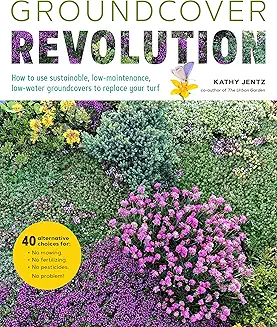
Groundcover Revolution by Kathy Jentz
The first chapter of this book says it all. The author immediately poses the question: Why replace turfgrass lawns? Other than the time and cost of maintaining a lawn, there is also the reality that many lawns are so compacted that they do not absorb rainwater; instead, the water runs off into the sewers and waterways, meanwhile polluting them with herbicides, pesticides and fertilizers. Then, there are steep slopes where the grass keeps the slopes from eroding but trying to mow them is extremely problematic.
The second chapter touts the benefits of groundcovers. For those seeking low maintenance, weed suppression should be at the top of the list. As a reader of this review, you need to know that I firmly hate the notion of the “perfect” lawn. Why does it have to be perfect, i.e.no weeds. That notion is at the top of the list of rationales for using herbicides. If the correct groundcover is chosen, however, it will create a solid mass of roots that shade the ground and thereby prevent weed seed germination. Ms. Jentz is happy to be more specific about which groundcovers to use for specific purposes in chapter 5.
I’m sure that most of you know you are batting your head against a wall if you try to grow grass in deep shade, usually under older trees with large canopies. Groundcovers can and should be your answer. Additionally, groundcovers provide wildlife support in the form of flowers that supply nectar and pollen for beneficial insects and food and shelter as well as nesting material for birds. Groundcovers also absorb stormwater, act as a filter for pollutants, combat erosion, and collect organic debris that breaks down and adds to the health of the soil.
Instead of paying for brown mulch, why not use a green mulch, i.e. a groundcover that holds in moisture and insulates the ground from temperature extremes? Besides, it’s a lot more attractive. Less profit perhaps for a landscape contractor but much healthier for the environment. There are many areas in a landscape that are difficult to maintain; many of these are mentioned by the author and are, of course, a natural for the inclusion of groundcovers. I was surprised to learn that Epimedium is so tough that it can hold its own and even swallow the ubiquitous English ivy.
The chapter on installing and maintaining groundcovers is mostly common sense but for those who have never done this, it will be quite helpful.
Selecting the right groundcover will be the most important part of the process. There is a very helpful chart in addition to her top forty groundcover profiles. The profiles describe the plant’s attributes as well as precautions or drawbacks plus the ideal growing conditions and care instructions. Each profile shows symbols that are applicable: desired light, drought and soggy soil tolerance, disease and deer resistance, soil and salt tolerance, whether evergreen, wildlife benefit, whether a leaf swallower, whether fast spreading or flowering, if tall, foliage interest, and resistance to fire. In addition, there is a small chart showing height, winter hardiness, bloom time, spread speed, soil type and native range.
The profiles include many well-known groundcovers but also some not-so-well-known such as Packera. Additionally, some of the profiles included information that I did not know, not easy to do since I’ve been in the business for forty-seven years. Groundcover Revolution is a valuable book for everyone who is a gardener.

The Complete Book of Ground Covers: 4000 Plants that Reduce Maintenance, Control Erosion, and Beautify the Landscape by Gary Lewis
This book is an excellent book to use as a resource after reading the Kathy Jentz book because it includes so many more possibilities. As you might expect, considering the number of plant profiles, this book is considerably larger than the Jentz book.
I loved Gary’s preface in which he says that he wrote the book in an attempt to bring groundcovers out of the utilitarian shadows (using them as a solution) into the light as valuable plants for their own use in design.
In his introduction, he differentiates rhizomatous plants from stoloniferous ones, important information since rhizomatous plants tend to spread more quickly. He also advocates, as does Kathy, for the environmental benefits of groundcovers. His chapter on installation and maintenance is similar but a bit more detailed.
In the chapter on designing with groundcovers, I was happy to see that Gary emphasized the importance of the type of foliage as well as the importance of foliage over flowers He also discusses design strategies such as creating smooth transitions from one space to another, using them to influence and enhance the visual experience, guiding physical movement through the garden, emphasizing garden features, adding multi-season interest, enlivening small and tight spaces, replacing lawn, supporting wildlife, covering walls and hardscape, and even creating green walls. There is a long section about combining groundcovers and excellent photographs to demonstrate how different species and cultivars of a genuscan be colorful and highly textured. Several lists will be helpful: fragrant and aromatic groundcovers, good companions for bulbs, dry shade lovers, moist or wet soil lovers, sunny slope stabilizers, hell strip (treelawn) survivors, saline tolerant groundcovers, those that want either acidic or alkaline soil and a very long list of those resistant to deer and rabbits. I’ve added post-its to the book where the lists are, particularly the one on deer and rabbit resistance. My list that I’ve compiled over the years isn’t nearly as complete.
The bulk of the book consists of profiles of 4000 groundcovers. If you are looking for something unusual, you will find it here. There were many groundcovers with which I was not acquainted so reading this book was quite enlightening. Many had accompanying photographs.
I highly recommend purchasing or at least reading both books because they complement each other.
Jentz, Kathy, Groundcover Revolution: How to use sustainable, low-maintenance, low-water groundcovers to replace your turf, Cool Press Springs, Beverly, Massachusetts, 2023.
Lewis, Gary, The Complete Book of Ground Covers: 4000 Plants that Reduce Maintenance, Control Erosion, and Beautify the Landscape, Timber Press, Portland, 2022.

0 Comments