

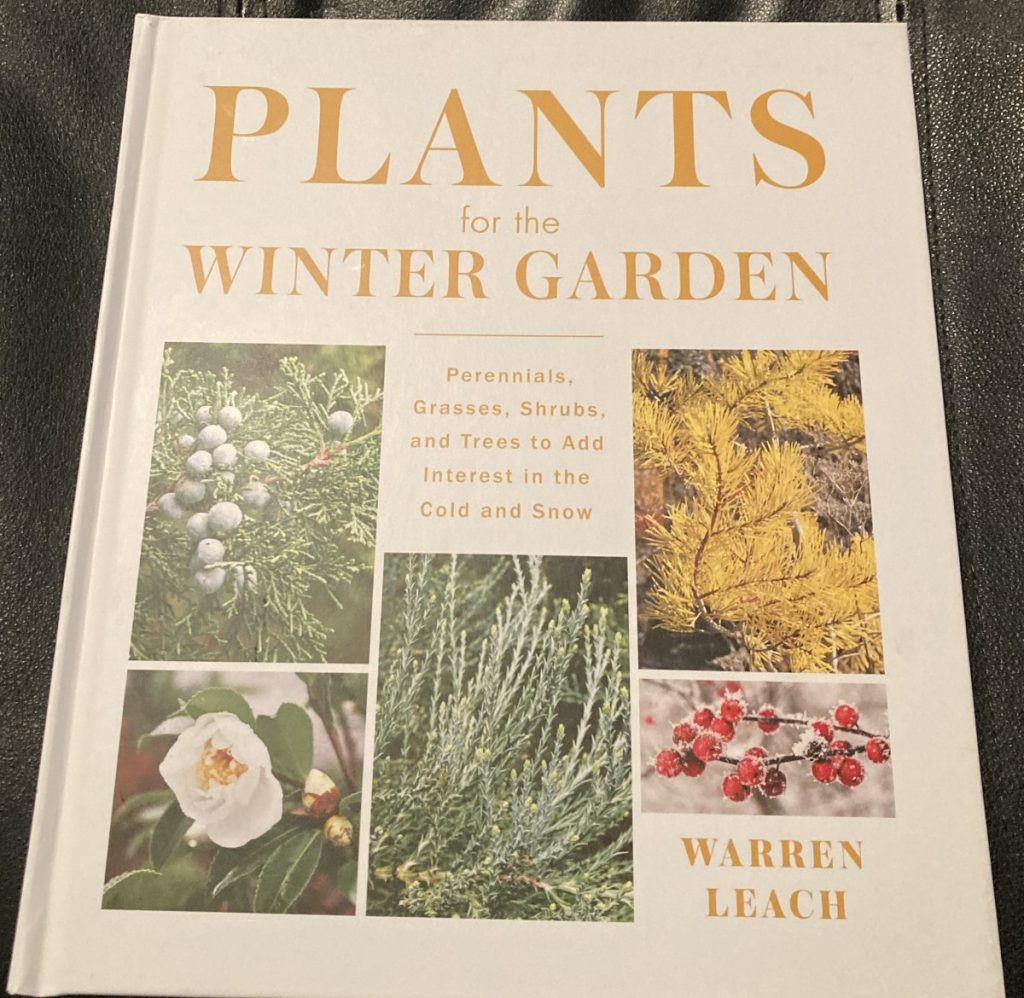
Plants for the Winter Garden
Warren Leach, the author of this book, encourages us to embrace winter by designing elements into our landscapes that are enhanced by the low angle of the sun, the wintry precipitation of ice and snow, and the shadows cast by bare branches and tree trunks.
Many of these elements will be missing if the perennials and ornamental grasses in our landscapes are cut to the ground in the fall. The deadheads remind us, of course, that the garden is not dead, merely dormant. However, if the deadheads are missing, they cannot become sculptures when encased in ice or snow nor can they provide food for birds. Leach also emphasizes that stems and leaves provide shelter and nesting sites for beneficial insects and pollinators. Since he grew up in Maine and now gardens in Massachusetts, many of the perennials he mentions for winter interest are hardy for those of us in Ohio.
Also essential to the winter landscape are conifers and broadleaf evergreens because green is perceived as the color of life. Such shrubs and trees also provide an excellent background for the flowers and deadheads of deciduous perennials and fruits of deciduous shrubs.
It never occurred to me that the leaves of conifers and broadleaf evergreens vary in the absorption or reflection of light depending on the type of foliage and Leach gives several examples of this phenomenon. He also discusses blue and yellow conifers that illuminate winter gardens and believes that he best foliar pairings mix contrasting textures and colors of broadleaf and coniferous evergreens. His photographs of various weeping confers make me want to find space for some.
Until I read this book, I had never heard the word marcescent. Leach uses this word to describe the “characteristic of some temperate woody plants to retain their dead or withered leaves throughout winter.” The best example is the foliage of American beech (Fagus grandifolia). Its pale coppery, herringbone veined leaves seem to reflect light and are quite beautiful when dusted with snow.
I have always loved exfoliating bark and Leach extols their beauty in winter landscapes. As you know, the bark is stands out more once the tree has defoliated. Both his words and photographs supply a range of an excellent choices. The one shrub with exfoliating bark that he mentions is Hydrangea quercifolia (Oakleaf Hydrangea).
Leach also reminds us that some trees and shrubs produce flower buds that are on display all winter. I do enjoy watching magnolia buds enlarge during the winter and the incipient sprays of Pieris japonica emerge during the fall and then turn rose late in the fall while turning white again in spring. He does mention some shrubs with winter flowers but most would not be hardy in northern Ohio. Shrubs and trees with colorful winter fruit abound but Leach is quick to mention that those fruits often disappear due to the appetite of hungry birds.
In contrast, the list of enduring deadheads and evergreen or evercolor foliage of perennials, ferns and ornamental grasses is quite long. I’ve never planted Galax urceolata (Wand Flower) but now plan to search for it because its foliage turns maroon during the winter and thrives in moist shade.
Using many of the plants he has mentioned during the major part of the book, Leach then demonstrates in six different examples how important structural forms are, particularly in entry landscapes. The he goes on to demonstrate the importance of keeping in mind what one sees looking out of building windows. A bonus is the short chapter on planting permanent pots. Now I’m rethinking my front porch containers that I fill with drought tolerant annuals each year. Lots of food for thought in this book.

0 Comments